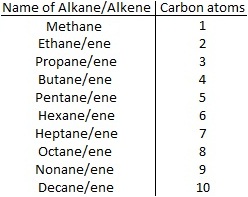
Each carbon atom bonds to 4 other Carbon or Hydrogen atoms in Alkanes and Alkenes, which are Hydrocarbons.
The general formula for alkanes is CnH2n+2
The general formula for alkenes is CnH2n
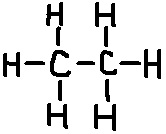
This means that Ethane looks like this:
Whereas, Ethene looks like this:
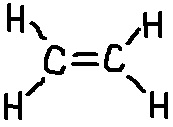
Alkanes have single Carbon-Carbon bonds, whereas Alkenes have a Carbon-Carbon double bond.
Alkanes and Alkenes can also have side chains which are bonded to the main chain:
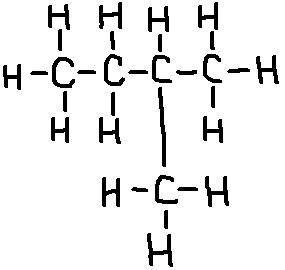
Firstly, we must find the longest chain of Carbon atoms in the molecule and this is the main chain in the molecule.
For this molecule the longest chain of Carbon atoms is 4, therefore it is a butane molecule.
We then look at the side chain, which for this molecule is similar to that of methane, but as a side chain it is called a methyl group, meaning this molecule (so far) is called Methylbutane.
Finally, we look for the Carbon atom the side chain is bonded to, to do this we count from the side of the main chain which is closest to the side chain, for this molecule, the side chain is bonded to the second Carbon atom, therefore the final name for this molecule is 2-methylbutane.
These rules apply for all molecules!
But what happens when there are multiple side chains?
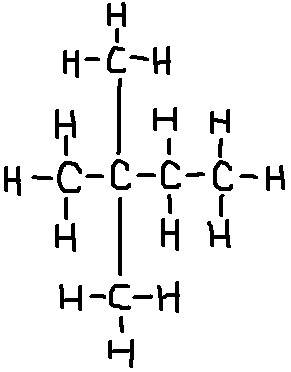
The longest chain of Carbon atoms is 4, therefore this is a butane molecule.
There are two methyl groups attached to the molecule, therefore, the molecule is called dimethylbutane.
Furthermore, starting from the side of the chain that is closest to the sidechain(s), we count the Carbon atom that the sidechain(s) are bonded to. In this case the two methyl groups are bonded to the second Carbon atom in the chain, therefore this molecule is called 2,2-dimethylbutane.
Commas are used to separate numbers from each other, whereas hyphens are to separate numbers from the name of the molecule, so you cannot call this molecule 2-2,dimethylbutane, it must be called 2,2-dimethylbutane.
The prefix of the name of the molecule depends on how many side chains there are attached to the molecule:
di=2 side chains
tri=3 side chains
tetra=4 side chains
What happens if there are multiple sidechains, which are not the same group (methyl, ethyl etc.)?
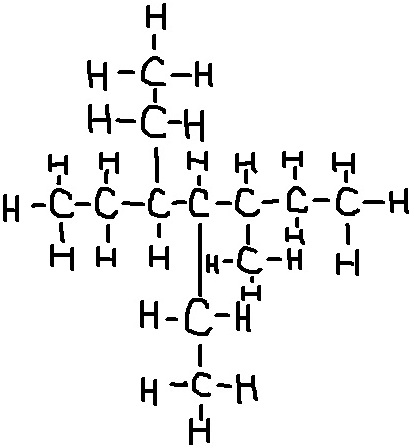
The longest chain of Carbon atoms is 7, so this is a heptane molecule.
Sidechains attached to the molecule include two ethyl groups and one methyl side chain.
Starting from the side of the chain that is closest to the sidechain(s), we count the Carbon atom that the sidechain(s) are bonded to. For this molecule, the two ethyl groups are bonded to the third and fourth Carbon atoms respectively, and the methyl group is bonded to the fifth Carbon atom.
Now, when formulating the name, sidechains are written alphabetically, ignoring the prefixes (di, tri, tetra), so ethyl comes before methyl when naming the molecule, so the molecule is called: 3,4-diethyl-5-methylheptane
Naming alkanes and alkenes is fairly logical, but if you still can't get your head around it, watch these:
